
Christmas morning, then
Everyone who grew up in the north of the Mason/Dixon line has certain image in their minds of a magical, snowy Christmas morning. We went back to the weather records and counted how many of those there actually were.
There’s a scene in the classic movie “A Christmas Story” where Ralphie wakes up on Christmas morning. He goes over to his bedroom window and opens it up to see a completely transformed and glistening backyard. Snow has covered everything. It’s the ideal Christmas morning we all have in our memories.
But how many of your childhood Christmases were white? (Don’t answer that if you grew up in Florida.) Most of us remember snow piled higher than we were tall, and if you’d asked, we’d have sworn every Christmas was white. The weather records tell a humbler story, town by town.
And you don’t have to have a major snow event to qualify for a white Christmas. Luckily for us, volunteer observers and National Weather Service staff members have walked out every Christmas morning just like they do every morning, and placed a ruler in the snow to determine how deep it was. And NOAA has every record from those Christmas mornings. And they’ve done this for more than a century!
Drop in your zip code and birth year into the fields below to see how many white christmases you had!
Find your childhood Christmases
Enter the city of your childhood and your birth year. The tool looks up the nearest weather station that has been recording data for a long time and has data for Christmas morning, then displays all Christmases from birth through age 18: the ones that were white, how deep the snow was, and the ones that reported new snowfall in the Christmas Day report. It will single out your whitest Christmas, the one with the most snow on the ground.
When you find yours, send the pic to your brother or your cousins. We all remember Christmases a little differently anyway, and now we have a referee.
What counts as a white Christmas
The answer is official, and not that complicated. NOAA defines a white Christmas as 1 inch of snow on the ground on Christmas morning. That’s all there is to it. It doesn’t need to snow that day. A few snowflakes may blow past your window while you eat dinner, but they don’t count if the ground was bare at breakfast.
It’s based on the station’s morning reading. At many volunteer stations, the observer reads the ruler around 7 a.m., so the Christmas reading tells you what was on the ground when you were running downstairs to see what Santa left. A reading of a trace, or anything under an inch, goes down as a green Christmas.
That rule leads to some comical close calls, listed below. It also means that a white Christmas could happen because of snow that fell a few days before. A storm that comes in on Dec. 21 and leaves snow still lying on Christmas morning counts the same as a storm that drops in on Christmas Eve.
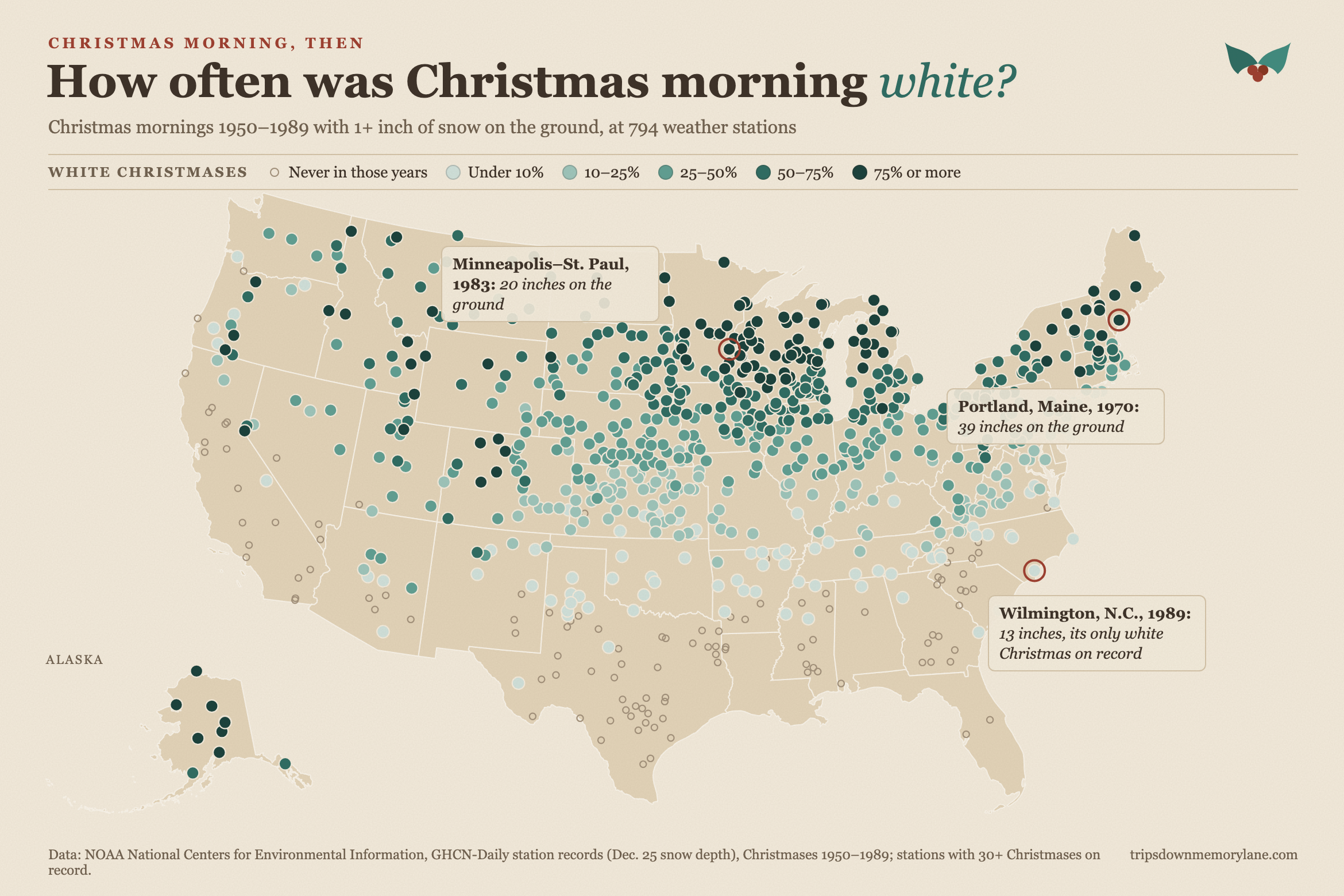
For the Christmases of 1950 through 1989, the years when most of our readers were young, we had enough records to map 794 long-running stations. At 306 of them, at least half of those Christmas mornings were white. At 114, not one was. And at 20 stations, every single Christmas morning on record in those years had snow on the ground. That list includes International Falls, Minn., which went 40 for 40; Fairbanks, Alaska; Hayward and Phelps, Wis.; Marquette, Mich.; and Crater Lake, Ore. If you grew up in one of those places, a green Christmas would have been the strange one.
Famous white Christmases, checked against the logs
Each of those is taken directly from the station’s daily log. When we say “the Christmas Day report,” it means what the station recorded on Dec. 25.
Western New York. Rochester’s airport station logged 18 inches of snow on Christmas Day 1978, on top of the 9 inches already on the ground that morning. It is the most Christmas Day snow in the station’s 100 Christmases on record, which go back to 1926. To the south, the volunteer station at Hornell recorded 26 inches of new snow in its Christmas Day report and 28 inches on the ground. Up on the Tug Hill Plateau, the station at Highmarket measured 51 inches on the ground.
Minneapolis–St. Paul. Twenty inches on the ground on Christmas morning at the airport. Nearby stations at Owatonna and Santiago, Minn., had 30 inches, and Cumberland, Wis., had 33. If you were a kid in the Twin Cities that year, that was a Christmas built for forts.
Wilmington, N.C. Thirteen inches of snow on the ground on Christmas morning, at a station not far from the Atlantic. The Christmas Eve report alone logged 4.7 inches. In 78 Christmases on record at Wilmington, it is the only white one. Kids who grew up on the Carolina coast in the 1980s have the rare honor of a white Christmas nobody else in their town has ever matched.
Corpus Christi, Texas. The airport logged 2.3 inches of snow on Christmas Eve and 2.1 more on Christmas Day, with 4 inches on the ground Christmas morning. In 70 Christmases on record there, going back to 1948, it is the only white one. Across West Texas that same morning, stations from Amarillo to Tahoka had 1 to 5 inches on the ground too.
Oklahoma City and Duluth. Oklahoma City’s airport logged 13.5 inches of snow on Christmas Eve and had 14 inches on the ground Christmas morning, the whitest of its 77 Christmases on record. Far to the north, Duluth, Minn., got 11 inches on Christmas Eve and 12.4 more on Christmas Day, the most Christmas Day snow in its 78 Christmases on record, with 22 inches on the ground.
The ones that almost counted
Because the official measurement is taken in the morning, several of the best snowy Christmases are technically classified as green.
In Albany, N.Y., in 2002, the ground had only a trace of snow on Christmas morning. Then 19.2 inches fell on Christmas Day, the most in the station’s 88 Christmases on record. In Little Rock, Ark., in 2012, Christmas morning was bare, and then 9 inches fell before the day was over, again the most Christmas Day snow in the station’s records, which go back to 1938. And in Erie, Pa., in 2017, the morning reading was 5 inches, which made it white, and then 20.9 more inches fell on Christmas Day, the most in Erie’s 99 Christmases on record. By evening, kids in all three cities had about as much snow as anyone could ask for. Officially, only Erie got the white Christmas.
The whitest Christmas mornings on record
If you want to know where Christmas morning has ever been deepest, the answer depends a lot on altitude.
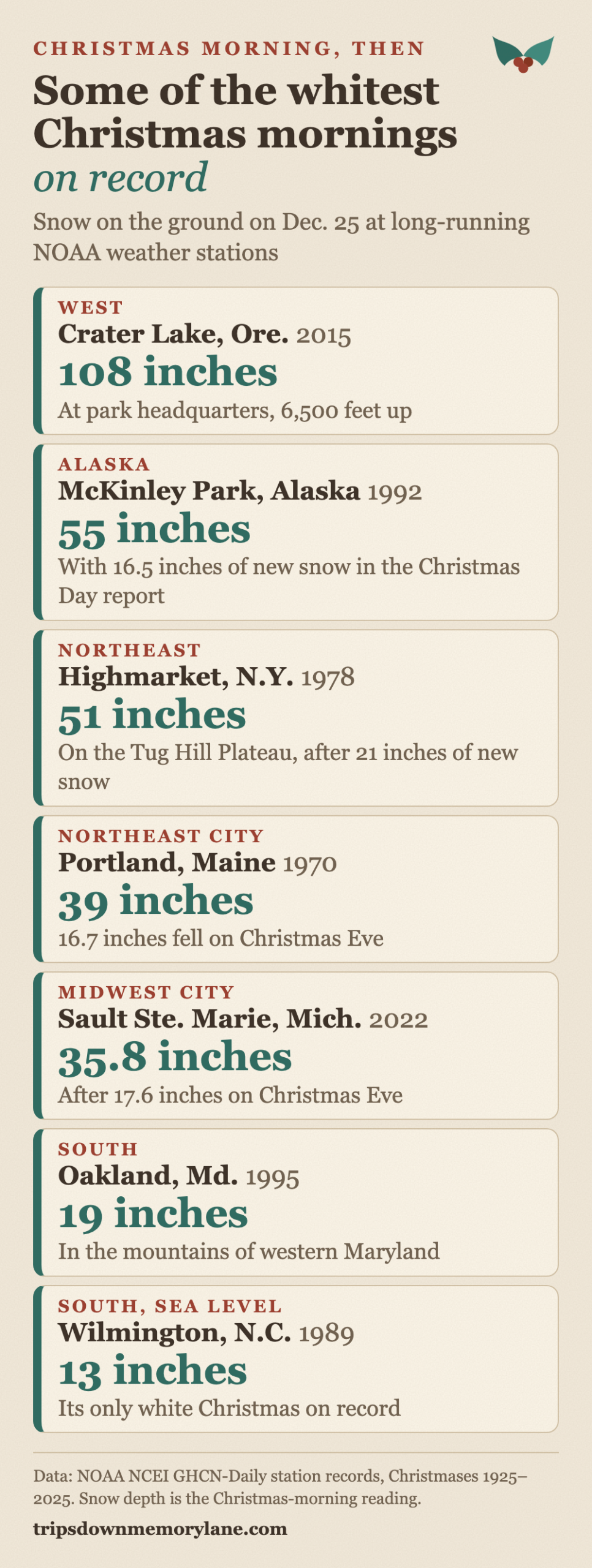
In the West, nothing touches Crater Lake National Park headquarters in Oregon, at about 6,500 feet. On Christmas morning 2015, the observer measured 108 inches of snow on the ground. That is 9 feet. A snowman up there would have needed a ladder.
In Alaska, McKinley Park had 55 inches on the ground on Christmas morning 1992, with 16.5 inches of new snow in its Christmas Day report.
In the Northeast, the Tug Hill Plateau in New York holds the top spot with Highmarket’s 51 inches in 1978. Among the bigger cities, Portland, Maine, and its 39 inches in 1970 is hard to beat.
In the Midwest, Sault Ste. Marie, Mich., had 35.8 inches on the ground on Christmas morning 2022, after 17.6 inches fell on Christmas Eve.
In the South, the mountain town of Oakland, Md., had 19 inches on Christmas morning 1995. At sea level, Wilmington’s 13 inches in 1989 stands alone.
Why “whitest” and not “snowiest”? Snowfall is what lands in a day. Snow depth is what is still lying on the ground, and that’s what makes a Christmas morning look like a Christmas card. A white Christmas is all about the depth, so that’s what we rank.
How we did it
The records. Christmas-morning snow depth and Christmas Eve and Christmas Day snowfall from NOAA’s National Centers for Environmental Information, Global Historical Climatology Network Daily (version 3.35, retrieved Oct. 9, 2026), for 913 long-running U.S. weather stations, covering Christmases from 1925 through 2025. The tool uses the station closest to your town that has Christmas-morning readings for at least six in ten of your childhood Christmases; if the very closest one has too many gaps in those years, it reaches out as far as 75 miles and tells you which station it used and how far away it is.
What we left out. We also excluded some measurements that didn’t pass NOAA quality-control tests. This could occur if, say, the reported depth was greater than all snowfall recorded at the station back to October or the depth was more than three times the morning snow depths in nearby comparable locations. On days when the ground was bare, old weather observation forms would leave the snow-depth boxes blank and NOAA counts these as a “presumed zero”. We followed suit and counted these as green, unless there was an inch or more reported on the day prior or following, or if there was snowfall reported on the blank-depth day. In such cases the year is reported as “no record”. This simply means there was no usable record for that Christmas. We never fill a gap with a guess.
Ages. The tool counts your age at each Christmas by birth year, so someone born in 1970 is 8 at Christmas 1978. If your birthday is Dec. 26, you have our sympathies and our permission to subtract one.
Snowfall timing. Snowfall at National Weather Service stations is recorded by calendar day. Many of the volunteer stations take their Dec. 25 report that morning covering the previous 24 hours, so “new snow in the Christmas Day report” may have fallen overnight on Christmas Eve. In either case it was there by the time the presents came out.
Now we want to hear yours. What do you remember about Christmas morning when you were a kid? Maybe it was the year the drifts covered the car, or the sled you got the one Christmas there was finally enough snow to use it, or the year it was 60 degrees and you rode your new bike in shorts. Tell us the town and the year, and we’ll pull up that morning in the weather log. Sometimes the snow was even deeper than you remember.
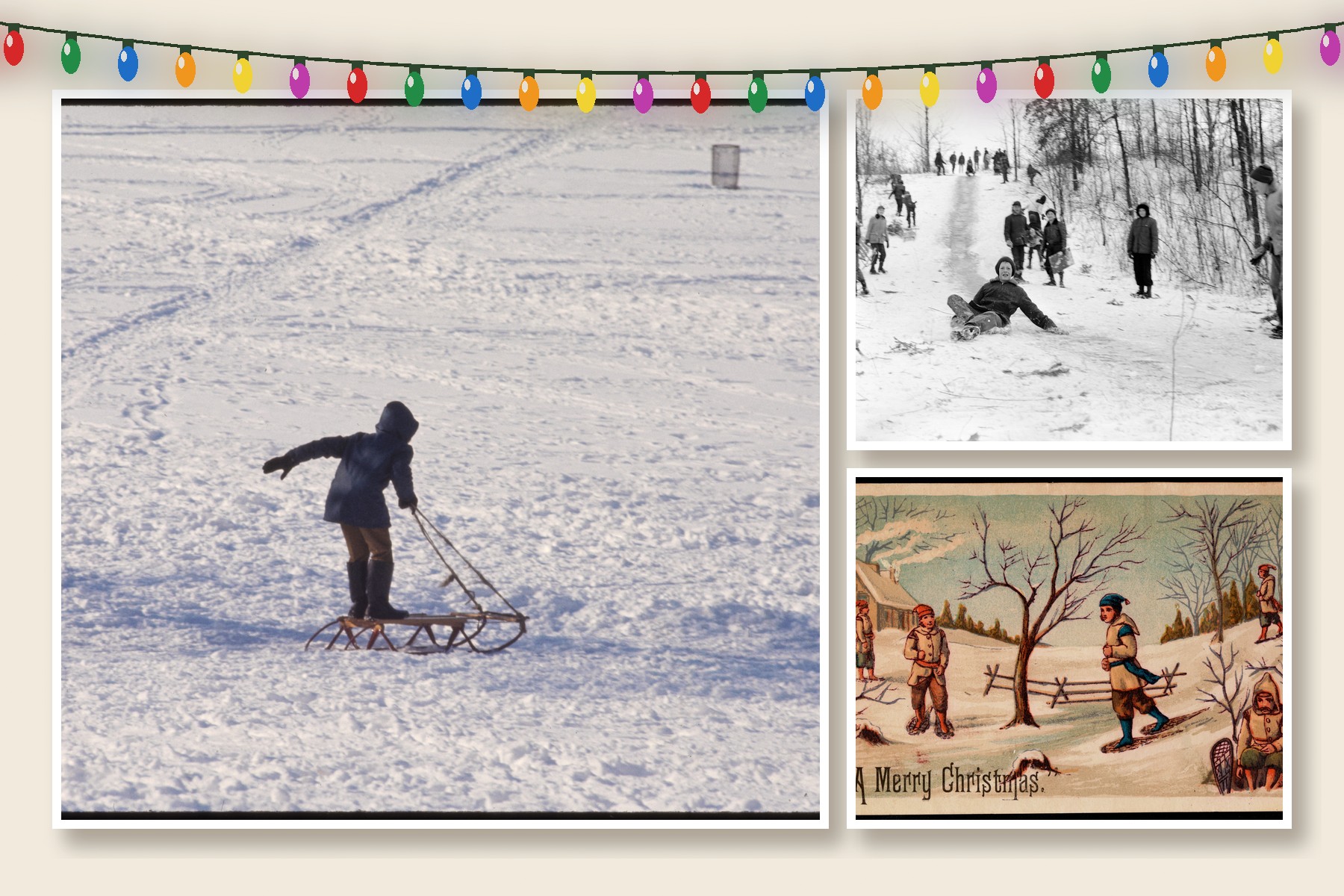
Top image, from left: a child pulls a sled across fresh snow in New York City, 1970 (Bernard Gotfryd, Library of Congress); sledding at Devil’s Hill, Columbus, Ohio, about 1955 (Columbus Metropolitan Library, public domain); and an American Christmas card from the 1880s (Digital Public Library of America, public domain).




Leave a Reply