
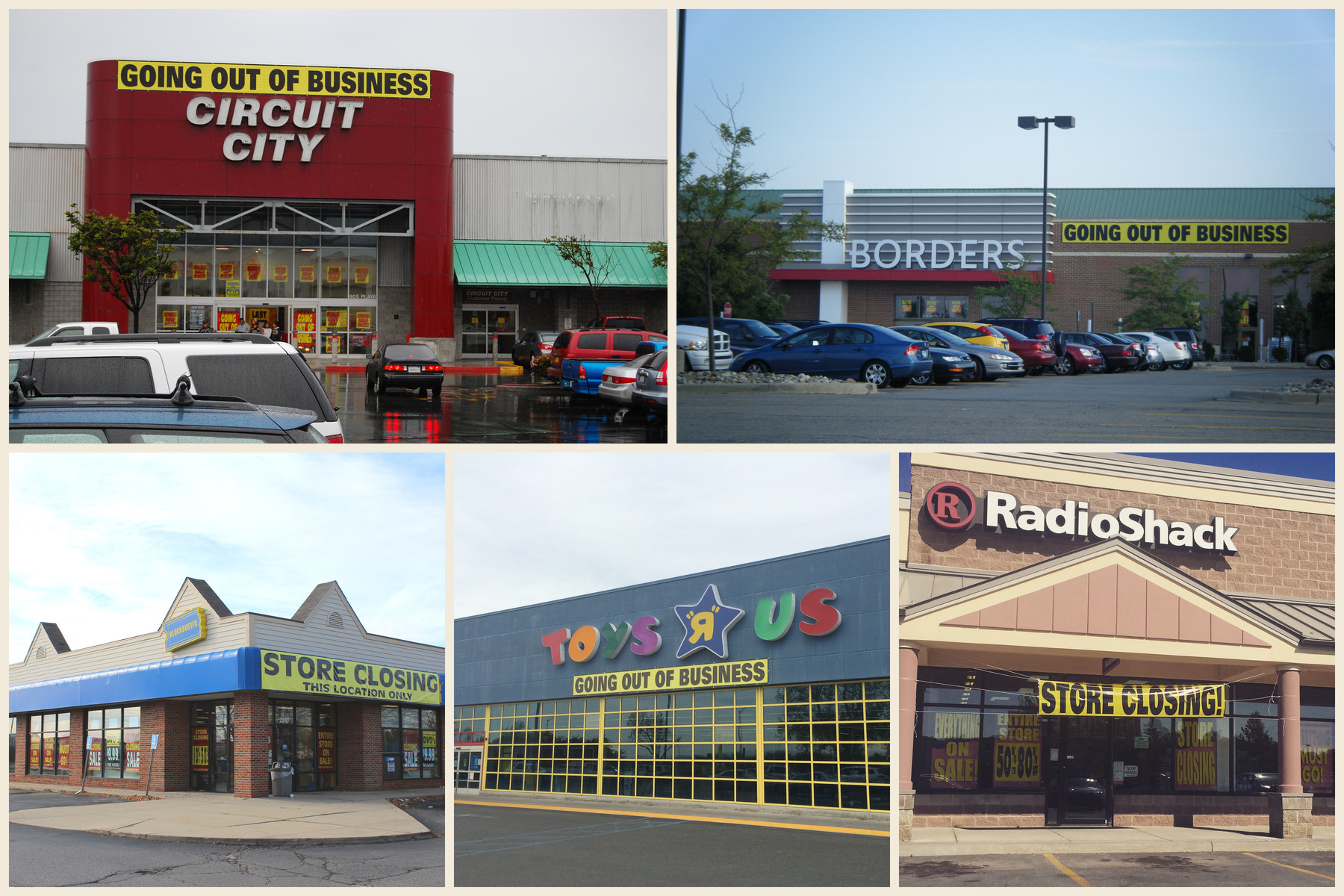
Circuit City, Borders, Blockbuster, Toys“R”Us and RadioShack were once a short drive from almost everyone. We lined them up at the starting gate and watched how long each took to disappear.
Nobody wanted to win this race, but somebody did. We dug into the filings and measured how long each company took to meet its end, from the biggest superstore count it ever reported in a year-end filing to the day its last store closed.
Borders, from peak to the last store, took a little over two and a half years. Blockbuster took nine years. Toys“R”Us appeared stable for the better part of a decade, but took twelve years in total. RadioShack’s collapse was so unconventional that it’s difficult to say it ever fully crossed the finish line. But the winner for quickest collapse from peak to empty parking lot? Circuit City, hands down. As of February 29, 2008, Circuit City’s year-end filing listed 682 superstores, more than it had ever reported. On March 8, 2009, its last store shuttered. From peak to empty took almost exactly one year.
From peak to zero: how fast each chain disappeared
- 1Circuit City682 superstores (Feb. 2008) to none (March 2009)1.0 years
- 2Borders515 superstores (Jan. 2009) to none (Sept. 2011)2.6 years
- 3Blockbuster4,708 company stores (end of 2004) to no company stores (Jan. 2014); 1 still open9.0 years
- 4Toys“R”Us901 Toys“R”Us and Babies“R”Us stores (Jan. 2006) to none (June 2018); 40 again in 202612.4 years
- 5RadioShack5,161 company stores (end of 2002) to about 70 (May 2017); no company stores by 202014+ years
At the end of 2007, the year our story starts, these five retail chains operated a total of 10,488 company-owned stores in the U.S. Ten and a half years later, all but one had shuttered every one of those stores. That remaining chain, RadioShack, still had a small handful of locations open. That’s a massive drop, even for companies as well known as these.
How the race works
Every publicly traded company files an annual report with the Securities and Exchange Commission. Most companies in retail include a table in these filings with a state-by-state breakdown of their number of stores. We pulled the annual filings from these five retailers for each year and counted the company-owned locations (not counting franchises, independent dealers or kiosks, as these are all reported differently and were owned by other people). The “peak” is the largest number of locations at the end of a year found in the companies’ SEC filings. The “finish line” is when the last company-owned store closed, as noted in company press releases or news reports in that week.
We started this race at the end of 2007, on the eve of the Great Recession. This was a time when each of these companies still had stores. It may have seemed at this point that these companies were fixtures forever. As you can see, this was not the case.
Circuit City: one year, start to finish
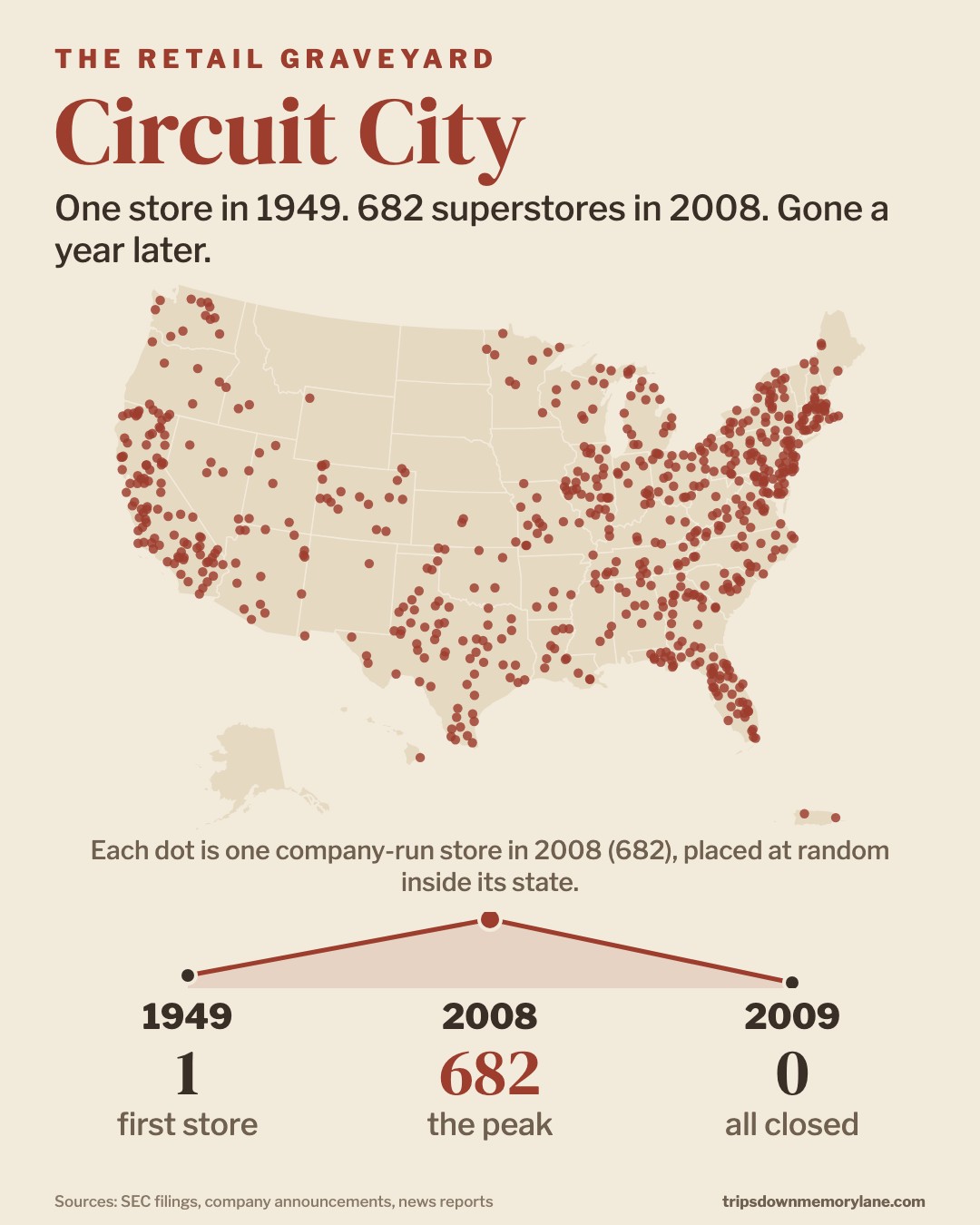
Countless families went to Circuit City for their first color TV, their first VCR, their first CD player. Circuit City began as a company called Wards in 1949 in Richmond, Virginia. Richmond’s Style Weekly explains that the W in Wards stood for company founder Samuel Wurtzel, the A stood for his son Alan, the R for his wife Ruth, the D for another son, David, and the S for…you guessed it, Samuel. Over the years, Circuit City’s cavernous walls of glowing screens and sales staff who actually knew the difference between said glowing screens gave many of us a strangely familiar feeling, as if walking in was somehow like coming home.
Something that blows our minds a little: as of August 2008, Circuit City stores were still opening! At the end of August 2008, per a quarterly report, Circuit City actually had 705 superstores, up from the 682 in its last annual report, which was up from 642, which had risen from 626 in the reports before that. (For peak Circuit City superstore presence by state: California 92, Texas 61, Florida 53.)
But then on November 10, 2008, just ten weeks later (!), Circuit City filed for bankruptcy protection after announcing it would be closing 155 stores, leaving it with just 567 superstores as of December 31, 2008. After that it was simply a matter of counting down the days and stores as the going-out-of-business sales dragged on through the winter after its January 16, 2009, announcement that the chain would be liquidated because it was unable to find a buyer. “Regrettably for the more than 30,000 employees of Circuit City and our loyal customers,” that announcement began. The last Circuit City stores closed on Sunday, March 8, 2009.
Borders: a bookstore you could get lost in
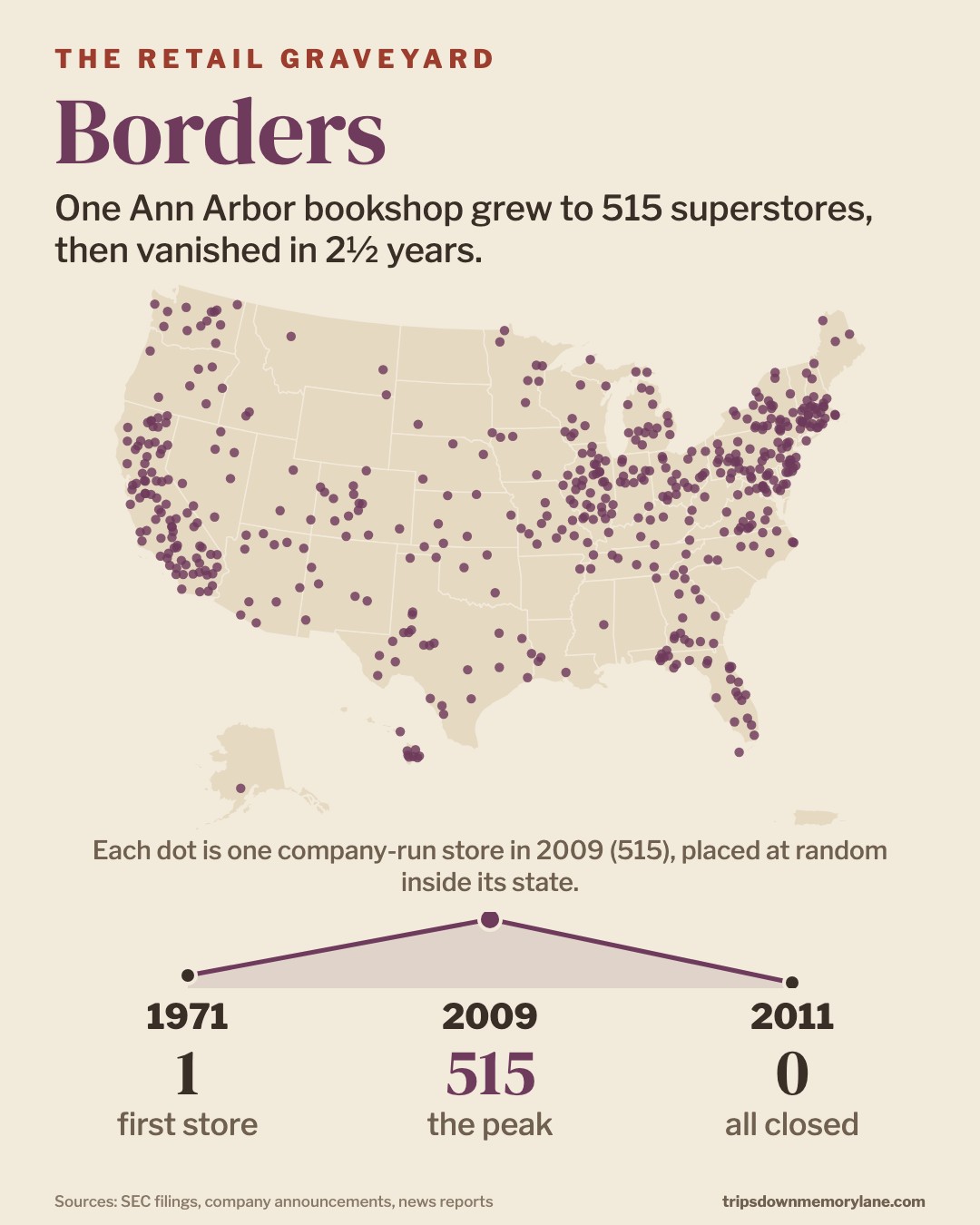
Remember those Borders superstores, where there was a café in just about every store, and you could sit down for an hour, peruse a book you weren’t thinking of purchasing, and no one would bother you? According to AnnArbor.com, brothers Tom Borders and Louis Borders started out with a small bookshop on South State Street in Ann Arbor, Michigan, in 1971. The business grew, and the final annual report indicated the typical Borders superstore carried 81,000 titles, making it easy to get lost there!
Borders filed for bankruptcy on February 16, 2011, and as part of this first step 226 Borders superstores would be closing. But this wasn’t yet the whole story. In July of 2011 Borders announced that it would be closing all of its stores and liquidating the entire business. At this time, Borders had 399 stores with around 10,700 employees. All Borders stores closed their doors for the final time on Sunday, September 18, 2011.
It’s shocking to see how fast the collapse of Borders happened. In its January 2009 annual report there were 515 Borders superstores, the most it ever had, and the count had gone up every year until then (not counting the smaller mall Waldenbooks stores, which were shrinking even as the superstores continued to expand, and which aren’t part of this race). At the chain’s peak, there were 82 superstores in California, 36 in Illinois, and 29 in New York. It’s staggering to look at the filing documents and realize how quickly all of these stores went from busy businesses to empty shells.
Blockbuster: the slow fade of Friday night
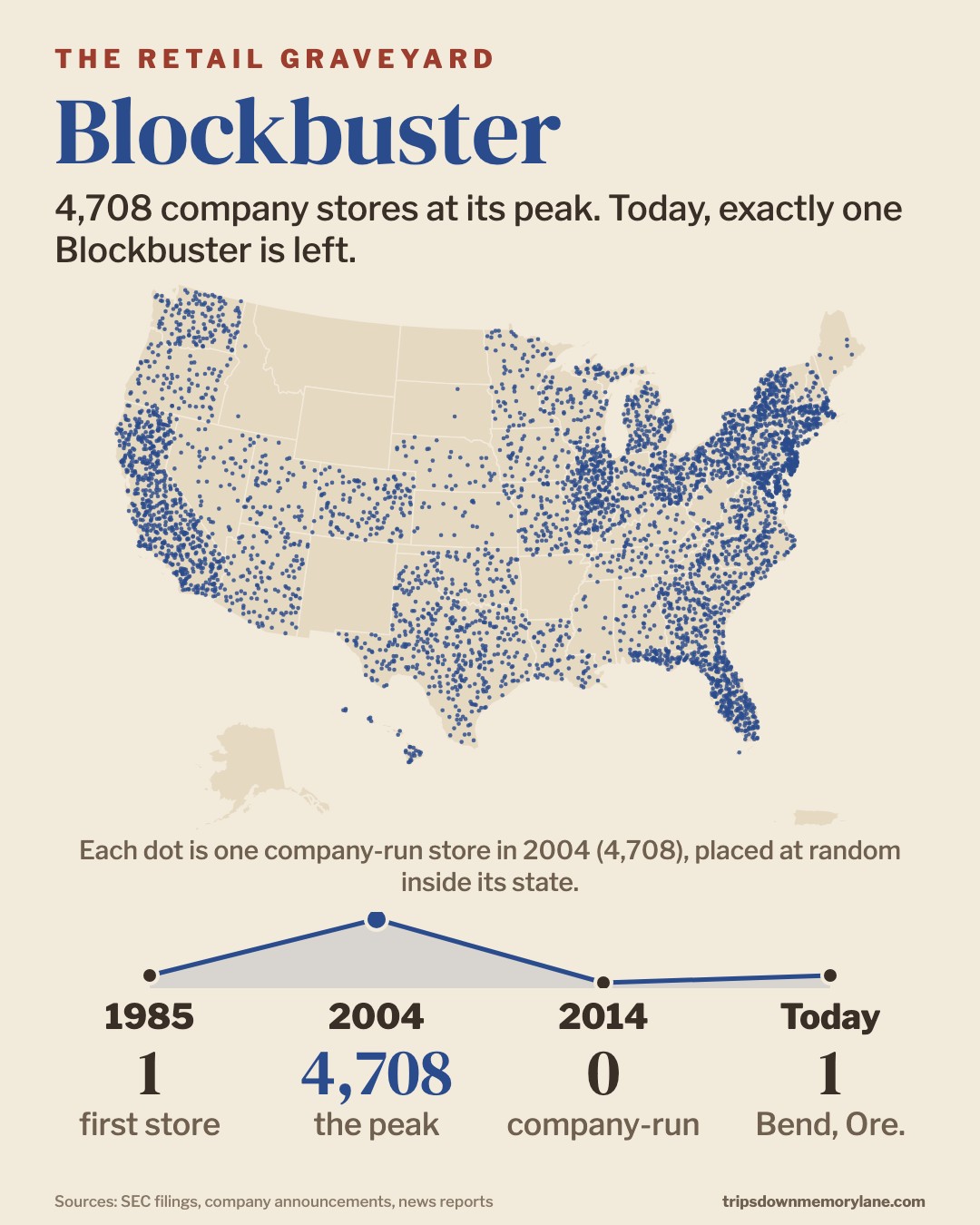
According to a 2003 Blockbuster report, Blockbuster locations were “generally open 365 days a year,” with most locations open until midnight. Blockbuster locations at one point were so common across the country that it’s almost difficult to imagine a time when they weren’t everywhere. For those born at the right time to make this part of your Friday night ritual, walking the length of the New Releases wall, searching for the one remaining copy of that must-see title and agonizing over whether or not to buy that candy bar when you brought that ridiculous tower of VHS tapes to the counter, Blockbuster locations may have been commonplace, but they were also a ritual. By the end of 2004 Blockbuster hit its peak with 4,708 company-owned stores in the U.S. (there were additional franchised stores run by independent owners). On January 1, 2005, the chain’s more than 4,500 locations stopped charging late fees, a popular decision with anyone who’s ever returned a tape after the due date.
Blockbuster takes bronze (after such a long race!) because, according to the paperwork, its implosion wasn’t exactly immediate. No, Blockbuster’s decline took quite some time. During the year 2010, it closed 771 stores in the U.S., and on September 23, 2010, the company filed for bankruptcy protection. (At its 2004 peak, Blockbuster had 623 company-run stores in California, 410 in Texas, and 376 in Florida.) On April 26, 2011, DISH Network bought what was left of Blockbuster and for a time continued to operate Blockbuster stores. But that too was temporary: At the end of 2011, DISH-owned Blockbusters numbered more than 1,500; a year later, it was down to about 800 and by the fall of 2013, just about 400. On November 6, 2013, DISH Network announced the closure of every remaining company-owned Blockbuster store and sure enough, by the beginning of January 2014, they had all been closed. Except for one that the company never owned. That independently owned Blockbuster in Bend, Oregon, has been open the whole time, and still is. Today, it’s Earth’s only operating Blockbuster, still happily renting out movies.
Toys“R”Us: the kids who didn’t want to grow up
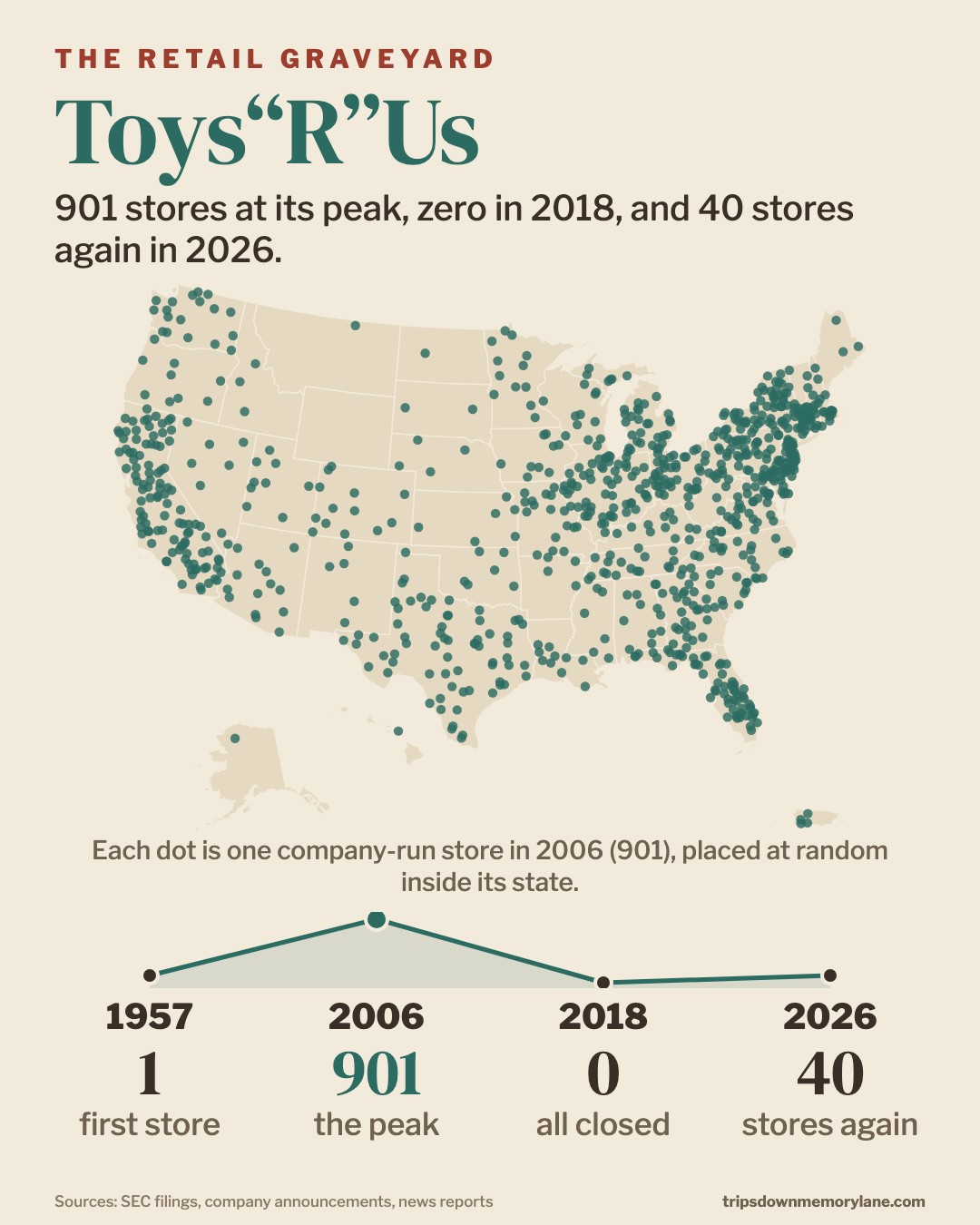
“I don’t wanna grow up, I’m a Toys“R”Us kid.” Chances are that no matter what generation you’re from, you can still sing the Toys“R”Us jingle (dating all the way back to 1982, according to CNBC). And you probably also remember what it felt like to enter the towering store: all those aisles upon aisles of action figures and board games and bikes, and the wish list you created on the trip home. Toys“R”Us started a sister store, fittingly named Babies“R”Us, in 1996; together the two banners had a whopping 901 U.S. stores in early 2006.
As surprising as the Toys“R”Us bankruptcy in 2017 was, the chain’s U.S. store count shows the equally surprising decline of its store footprint that followed. From 2008 through 2016 the number of U.S. Toys“R”Us locations changed little, always somewhere between 846 and 879. Then, on September 18, 2017, the company filed for bankruptcy. At that point, astonishing as it seems, it actually had more stores (881, six weeks after its bankruptcy filing) than it had in those previous years. On March 15, 2018, the company said all of its remaining 735 U.S. stores would close. And close they did, over just three and a half months, like a sprinter off the blocks after standing at the starting gate for ten years: on Friday, June 29, 2018, the last U.S. Toys“R”Us went dark. Since then, the toy store’s new owners have breathed some life back into the brand, first with shops within Macy’s and, more recently, in freestanding stores. In September 2026, the company said it had 40 freestanding U.S. stores, with plans for 120 more in time for the holidays.
RadioShack: the long goodbye
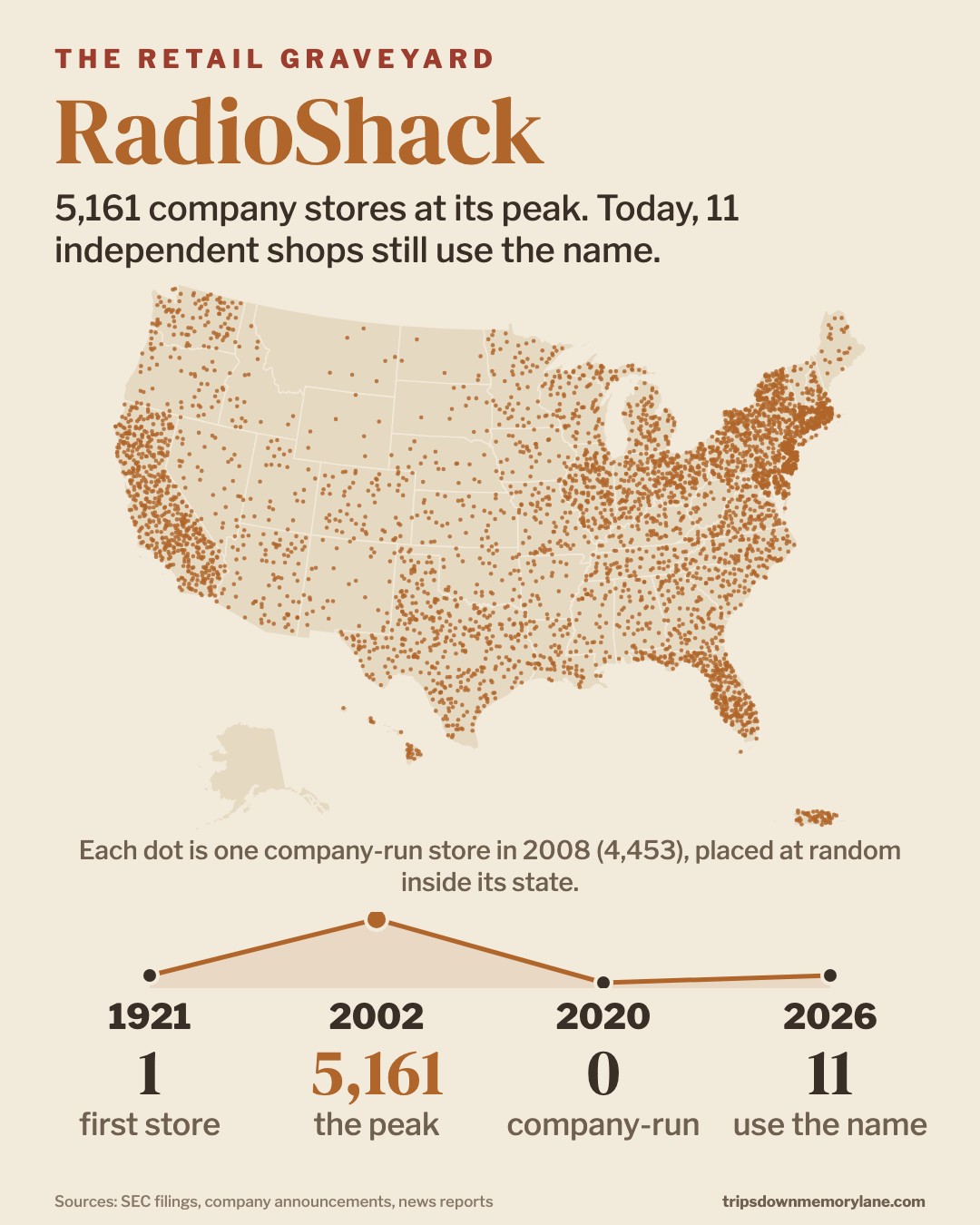
For many Americans, RadioShack was where they saw a computer for the first time. Parent company Tandy, based in Fort Worth, released the TRS-80 computer in 1977. The base Model 1 system included a monitor and sold for $599, IEEE Spectrum reports. RadioShack was so much more than a place you popped into to pick up a phone charger. For decades it was the answer to every “do you have a …?” question, a purveyor of the esoterica required to breathe life back into that special piece of hardware. Remote-control cars, resistors, cables, and of course batteries. RadioShack was the one-stop shop for all your minor electronics-related needs.
RadioShack ran more stores of its own than any chain in this race, peaking at 5,161 company stores at the end of 2002, and, hey, it held on to most of them for a remarkably long time. As of the end of 2013 (eleven years after the peak!), RadioShack still had 4,297 company stores, 83 percent of its peak count. (And California alone had a peak of 552.) Then it came apart in two bankruptcies. RadioShack filed for bankruptcy for the first time on February 5, 2015. As part of the proceedings, RadioShack sold 1,743 of its stores to General Wireless as of April 1, 2015; the rest of the stores closed their doors. As it turns out, General Wireless filed for bankruptcy on March 8, 2017. Trade publications reported that RadioShack had only about seventy company stores left as of the end of May 2017. Those stores closed without fanfare (i.e. there is no “RadioShack’s Last Stores Close” headline). Fox Business reported in November 2020 that all company-owned RadioShacks had closed but around four hundred RadioShack-branded independent dealers were still in operation.
You can still see RadioShack signs in odd places. Turns out the company’s own store locator lists 103 independent RadioShack dealers across the U.S., 11 of which actually have RadioShack in their name. None of those dealers are run by the company. So in the race of companies above, RadioShack finished last, with an asterisk, being the only one not to reach the finish line. Getting to just a few dozen stores took more than 14 years from its peak. Getting to zero took less than 18.
Look up your state: the most stores each chain ever had there
Next we present our findings in the form of a table. Each row corresponds to a state; each column corresponds to a retail chain. The big number represents the largest number of stores the chain had open in the state at one time (according to its annual reports), with the smaller number underneath indicating the year in which there were this many stores. We think it can be fun, and can yield some surprising results, to look up the peak number of stores in your state. (We went through the filings carefully to make sure we got these numbers right, and we think you might enjoy the results!) A 0 indicates that the company never ran a store of its own in that state, though some of those states had franchise or dealer stores instead.
| State | Circuit City | Borders | Blockbuster | RadioShack | Toys“R”Us |
|---|---|---|---|---|---|
| Alabama | 92007 | 0 | 432006 | 512012 | 101998–99, 2005–07, 2012–13 |
| Alaska | 0 | 12001–09 | 0 | 0 | 11998–99, 2005–16 |
| Arizona | 152007 | 122006–07 | 1272004 | 792009 | 172012–13, 2016 |
| Arkansas | 42002, 2006–07 | 12006–09 | 12004–05 | 292012 | 52007–16 |
| California | 922007 | 822008 | 6232004 | 5522010 | 1142013 |
| Colorado | 172007 | 142006–08 | 1272004 | 642011 | 131998–99, 2005 |
| Connecticut | 102007 | 112008–09 | 412004–06 | 702008–10 | 152005–06 |
| Delaware | 32007 | 22001–09 | 132009 | 192009–11 | 31998–99, 2005–16 |
| District of Columbia | 0 | 32001–09 | 72004 | 132008–10 | 0 |
| Florida | 532007 | 262003–04, 2008 | 3762004–05 | 3022010–11 | 612005 |
| Georgia | 242007 | 152002–03, 2005–09 | 1872006 | 1022010–11 | 292005, 2013 |
| Hawaii | 12002–07 | 82007–09 | 252004–05 | 242008–13 | 52016 |
| Idaho | 22002–07 | 22003–09 | 22004 | 192008–10 | 32005–12 |
| Illinois | 352002 | 362007–09 | 2502004 | 1732009–10 | 422005 |
| Indiana | 152002 | 132008–09 | 752004 | 982008–11 | 192005, 2016 |
| Iowa | 0 | 42004–09 | 452004–05 | 352009 | 92005 |
| Kansas | 52002 | 72004–07 | 222004–05 | 382008 | 61998–99, 2005–16 |
| Kentucky | 72003–07 | 52005–09 | 392007 | 562009 | 112011 |
| Louisiana | 122007 | 32008–09 | 672004, 2007 | 682012–13 | 121998–99 |
| Maine | 32005–07 | 32006–09 | 62004–09 | 222008–13 | 31998, 2005–16 |
| Maryland | 182007 | 122004–07 | 1132004 | 982009–11 | 221998–99, 2005 |
| Massachusetts | 182007 | 162008–09 | 722008 | 1152011 | 242005 |
| Michigan | 242003 | 192008 | 1682004 | 1212008 | 352005 |
| Minnesota | 92002, 2006–07 | 82003–06 | 712004 | 622008–09 | 131998 |
| Mississippi | 52005–07 | 12002–09 | 142005 | 382010–11 | 72014–15 |
| Missouri | 122002, 2007 | 112008–09 | 982004 | 722009 | 182005, 2014 |
| Montana | 0 | 32003–09 | 0 | 72008–11 | 11998–99, 2005–16 |
| Nebraska | 22002 | 32007–09 | 332004 | 212009 | 42005–12 |
| Nevada | 62006–07 | 72008–09 | 492004–05 | 382008–11 | 102011–16 |
| New Hampshire | 62005–07 | 42003–09 | 192008 | 322008–10 | 72005–16 |
| New Jersey | 192006–07 | 172003–04, 2006 | 1332004–05 | 1602010–11 | 452016 |
| New Mexico | 22004–07 | 52005–09 | 0 | 322008–09 | 52005 |
| New York | 352007 | 292006–07 | 2862004 | 3342011 | 632011–12, 2014 |
| North Carolina | 212006–07 | 102006–09 | 1602005 | 1252010–11 | 222005, 2016 |
| North Dakota | 0 | 0 | 0 | 62008–13 | 11998–99, 2005–16 |
| Ohio | 272002 | 202007 | 1912004 | 1882010 | 411999, 2005 |
| Oklahoma | 62007 | 42001–09 | 682004 | 392008–10 | 82015 |
| Oregon | 72002–07 | 72001–09 | 832004 | 522010–11 | 101999, 2014–16 |
| Pennsylvania | 302006–07 | 252007–08 | 1922004 | 2112010–11 | 472010, 2012–13 |
| Puerto Rico | 22007 | 0 | 0 | 602011–12 | 82010 |
| Rhode Island | 12002–07 | 22001–09 | 122008 | 212008–11 | 21998–99, 2005–16 |
| South Carolina | 102007 | 0 | 762006 | 562012–13 | 121998–99, 2005 |
| South Dakota | 0 | 12001–09 | 22004–05 | 112008–12 | 21998–99, 2005–16 |
| Tennessee | 142007 | 72006–09 | 542005 | 692008 | 191999 |
| Texas | 612007 | 242008 | 4102004 | 3772011 | 671998–99, 2014 |
| Utah | 52002–07 | 42002–05 | 652005 | 282009–11 | 92005 |
| Vermont | 12002–07 | 12001–09 | 82006–09 | 92008–13 | 11998–99, 2005–16 |
| Virginia | 252002 | 152006–09 | 1062004 | 1242008–10 | 291998 |
| Washington | 122002, 2006–07 | 132007–09 | 1322004 | 912008–10 | 182005 |
| West Virginia | 42002–07 | 22006–09 | 152009 | 282008–13 | 51998 |
| Wisconsin | 82002–03 | 62002–09 | 722004 | 702008–11 | 122014–16 |
| Wyoming | 12002–07 | 0 | 0 | 72008–09 | 0 |
Years of state-by-state reporting: Circuit City 2002 to 2007 (superstores only); Borders 2001 to 2009 (superstores only); Blockbuster 2004 to 2009; RadioShack 2008 to 2013; Toys“R”Us 1998, 1999 and 2005 to 2016 (Toys“R”Us and Babies“R”Us combined). Years are fiscal years. A state’s true high point could have come in a year the company didn’t report by state.
The stragglers
As we mentioned above, DISH closed its last company-operated Blockbuster locations during 2013 and 2014, but around 50 franchised Blockbusters were still operating. Two of the last franchise stores, in Anchorage and Fairbanks, Alaska, stopped renting movies in July 2018, and the Blockbuster in Perth, Australia, shut its doors in March of 2019. That left one Blockbuster still open, as the store in Bend, Oregon, was (and still is!) the last Blockbuster on Earth.
Toys“R”Us came back in small ways. On November 27, 2019, a new Toys“R”Us store opened at the Garden State Plaza mall in Paramus, New Jersey. (It closed in January 2021.) In October 2022, Toys“R”Us stores-in-stores opened in 451 Macy’s department stores. And since 2025, Toys“R”Us has been opening standalone stores again! RadioShack’s name is being propped up by the independent dealers that still sell under it, and the others (like Circuit City or Borders) only exist in our minds, and for many people, in the knowledge of exactly where the stores used to be.
How we built this
Store counts. Every number comes primarily from each company’s Form 10-K annual reports filed with the SEC. Some counts came from each company’s quarterly reports (known as Form 10-Q) or other announcements to the SEC (Form 8-K). Blockbuster store counts after April 2011 came from DISH Network reports (DISH was Blockbuster’s new owner). Store counts for RadioShack after 2015 (while it was owned by a private company), and for each chain’s final day, came from news reports at the time. It gives the real picture, certainly, but it took some legwork to get a good picture of each.
Store types. Seems pretty cut and dried, but for each chain, we only included corporate stores of the same type every year to try and get a true depiction of what happened historically with each company. So in the case of Circuit City, we only included the Circuit City superstores; for Borders we only included the superstores (no Waldenbooks or airport stores). We only counted the Blockbuster stores run by Blockbuster. Only corporate RadioShack locations (no dealers, no kiosks). In the case of Toys“R”Us, we counted Toys“R”Us and Babies“R”Us but not Kids“R”Us locations. Puerto Rico, Guam and U.S. Virgin Islands locations were included in store counts when the companies included them.
Dates. We have been careful about the dates, since some of these chains had a fiscal year ending in January or February, and we shifted those counts to the nearest December 31 (e.g., a count taken February 2, 2008, was counted as the end of 2007). Occasionally you will encounter a count labeled with the particular month of the year it was taken, because it came from the middle of a year. If a source only reports a rough number such as “over 1,500” or “approximately 800,” we use the same wording.
The dots. Each of the maps above plots every company-operated store, as of the state-by-state breakdown from nearest each retail chain’s heyday (Circuit City’s from early 2008, Borders’s from January 2009, Blockbuster’s from the end of 2004, Toys“R”Us’ from January 2006 and RadioShack’s from the end of 2008, which was the first year it reported such figures), with a single dot, plotted at a random location within the relevant state (since the filings don’t give store addresses). A handful of stores in Guam and the U.S. Virgin Islands count toward the totals but not toward the drawings.
Peaks and finish lines. To find each peak, we looked at the annual reports and identified the highest year-end store count for each chain. Circuit City had 705 superstores as of August 2008, slightly above its peak year-end total, but all chains were counted the same way. From there, the runs all go to zero. The “peak to zero” period begins on the date of the peak count and ends on the final day that any company-owned store was open.
Sources
- SEC EDGAR filings: Circuit City Stores (CIK 104599), Borders Group (CIK 940510), Blockbuster Inc. (CIK 1085734), RadioShack Corp. (CIK 96289), Toys“R”Us Inc. (CIK 1005414) and DISH Network (CIK 1001082), 1994 to 2018.
- Circuit City liquidation announcement, Jan. 16, 2009: sec.gov; final day: Press Democrat, March 8, 2009.
- Borders liquidation announcement, July 18, 2011: sec.gov; final day: Associated Press via Bangor Daily News, Sept. 18, 2011.
- Blockbuster store counts under DISH: DISH Network quarterly report, Q3 2013; franchise stores: Associated Press via MPR News, Nov. 6, 2013; Alaska: Anchorage Daily News, July 12, 2018; Bend: Engadget, March 7, 2019.
- Toys“R”Us wind-down announcement, March 15, 2018: sec.gov; final day: Associated Press via Fox 4, June 28, 2018; Paramus store: Fox 5 New York and Associated Press via KPRC, Jan. 29, 2021; Macy’s shops: Fox Business via Fox 32, Oct. 16, 2022.
- RadioShack sale to General Wireless, April 1, 2015: sec.gov; second bankruptcy: 24/7 Wall St., March 8, 2017; about 70 stores left: TWICE, May 30, 2017; corporate stores gone: Fox Business, Nov. 19, 2020.
- First stores: Blockbuster, History.com; Toys“R”Us, Fortune, March 22, 2018. Still open: the Bend, Oregon, Blockbuster, Central Oregon Daily, 2024; Toys“R”Us standalone stores, company announcement, Sept. 17, 2026; RadioShack dealers, radioshack.com store locator, checked Oct. 14, 2026.





Leave a Reply