First came a brand-new coloring book (featuring a cowboy or a favorite cartoon star on the cover). You grabbed a fresh box of Crayola crayons (whose waxy scent filled your nostrils when you cracked the box and whose points were mighty sharp when you pulled them out). Then you diligently toiled away at the kitchen table (or on the living-room floor), concentrating on staying within the lines. And when a crayon snapped in half, you carefully peeled the wrapper from the broken end. Coloring provided quiet entertainment on a summer or a rainy day and took up many an afternoon.
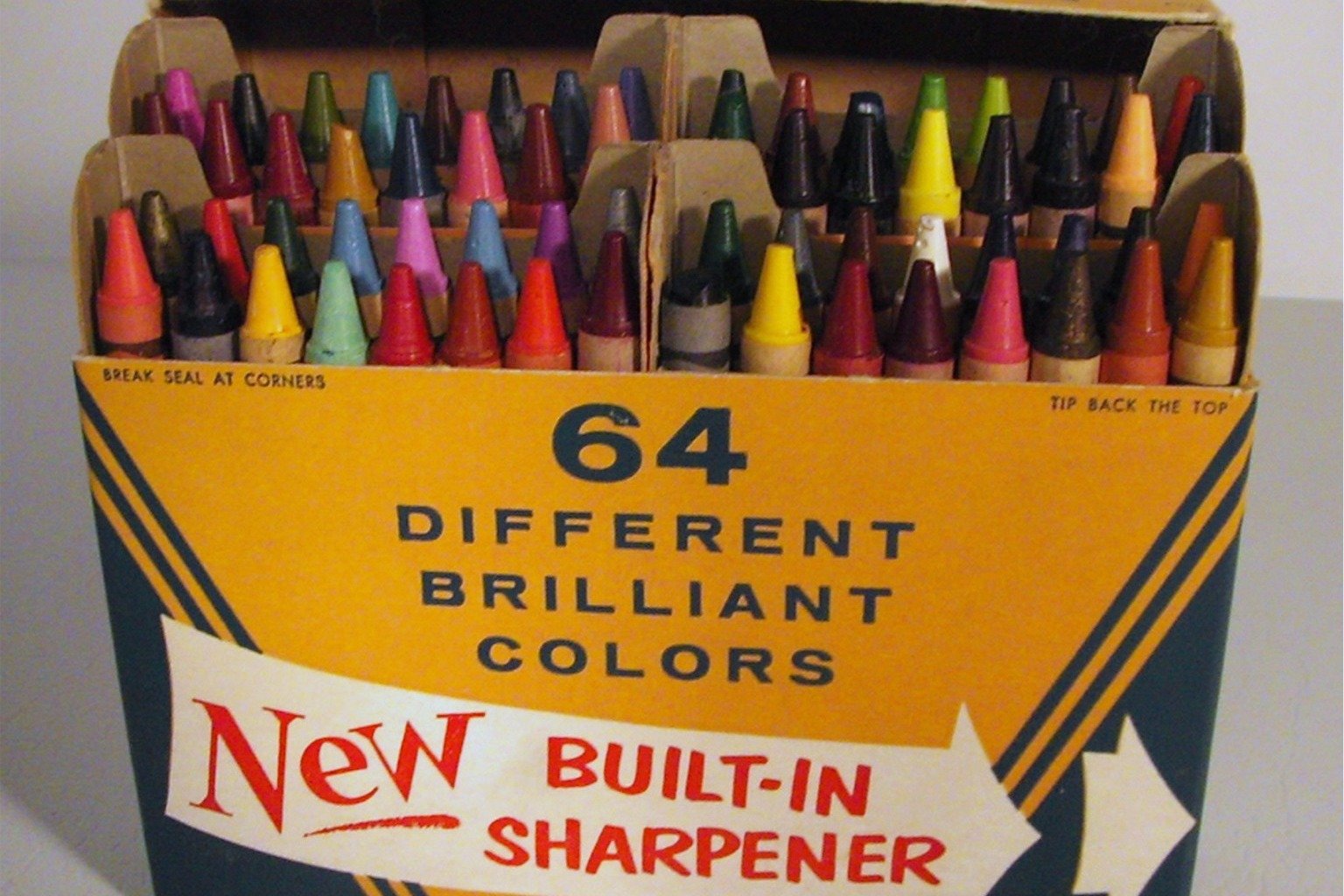
If you were a kid in the 1950s, chances are these scenes will be fondly recalled. I was born in 1950 and grew up in Southern Ohio, so I was eight when Crayola introduced a box of 64 Crayolas that had a crayon sharpener built into the box, which was a marvelous feat of engineering, if you ask me. Take a trip down memory lane with me through the coloring books of the 1950s, ’60s and ’70s. Learn about popular coloring book publishers, coloring books featuring TV stars of the times, the advent of paint-with-water coloring books, and that marvelous invention, the Magic Slate. Some retro coloring books are still on sale today, too, so you can pick one (or more) up for yourself or pass them on to your grandchildren.
1. The Painting Books That Came First
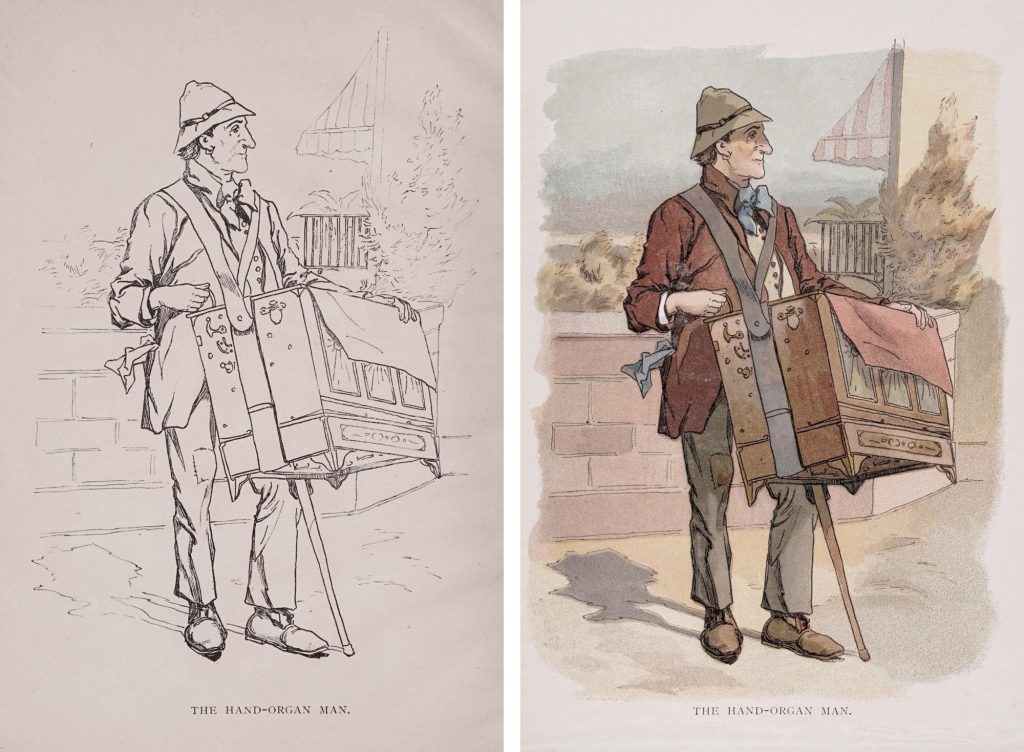
The first coloring books were really painting books, designed to be colored with watercolors, because wax crayons didn’t become popular until the 20th century. Those painting books began a tradition that has lasted well over a century.
One early favorite was The “Little Folks” Painting Book. Appearing in 1879, it is chock-full of cute little outline drawings done by Kate Greenaway, with verses by George Weatherly, which children could bring to life by adding color. Many a history credits McLoughlin Brothers as its publisher, but the title page of the 1879 edition indicates Cassell, Petter & Galpin of London, Paris and New York as publisher.
McLoughlin Brothers did publish children’s books from the mid-1800s to the early 1900s, however, and they helped make children’s coloring books popular. Their Palette Painting Book of 1892 printed a completed colored example next to the black-and-white picture to encourage the child to duplicate the colors. It opened with a page of practical instructions for young painters. In 1894, Hood’s Sarsaparilla introduced a painting book to promote its product. The promotional ones provided children with a creative activity to do at home, and promoted a product at the same time.
2. A Nickel for Eight Crayolas
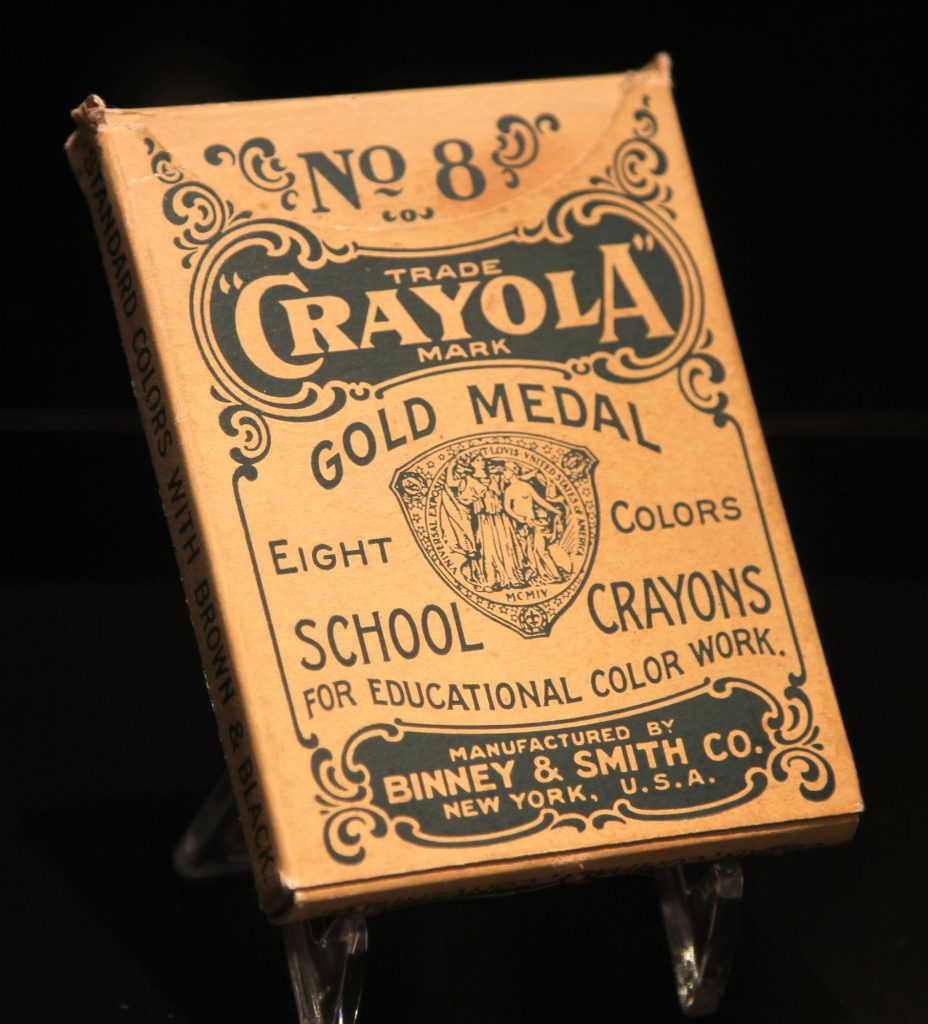
Did you know that in 1903 Binney & Smith, which made its crayons in Easton, Pennsylvania, sold the first box of Crayola crayons for just a nickel? For that nickel you got eight colors: red, orange, yellow, green, blue, violet, brown and black.
The Crayola name is an amalgamation of craie (the French word for chalk) and ola, from oleaginous (oily). It was the brainchild of Edwin Binney’s wife Alice Binney who had been a schoolteacher. The company was owned by Edwin Binney and his cousin, C. Harold Smith. Initially, Binney & Smith made carbon black and red oxide pigment that was used in barn paint. In 1902, the partners created a dustless school chalk. Soon after that they created a paraffin wax and nontoxic pigment based coloring stick that was sturdy, affordable, and safe for schools.
3. The 48 Box, Then the Mighty 64
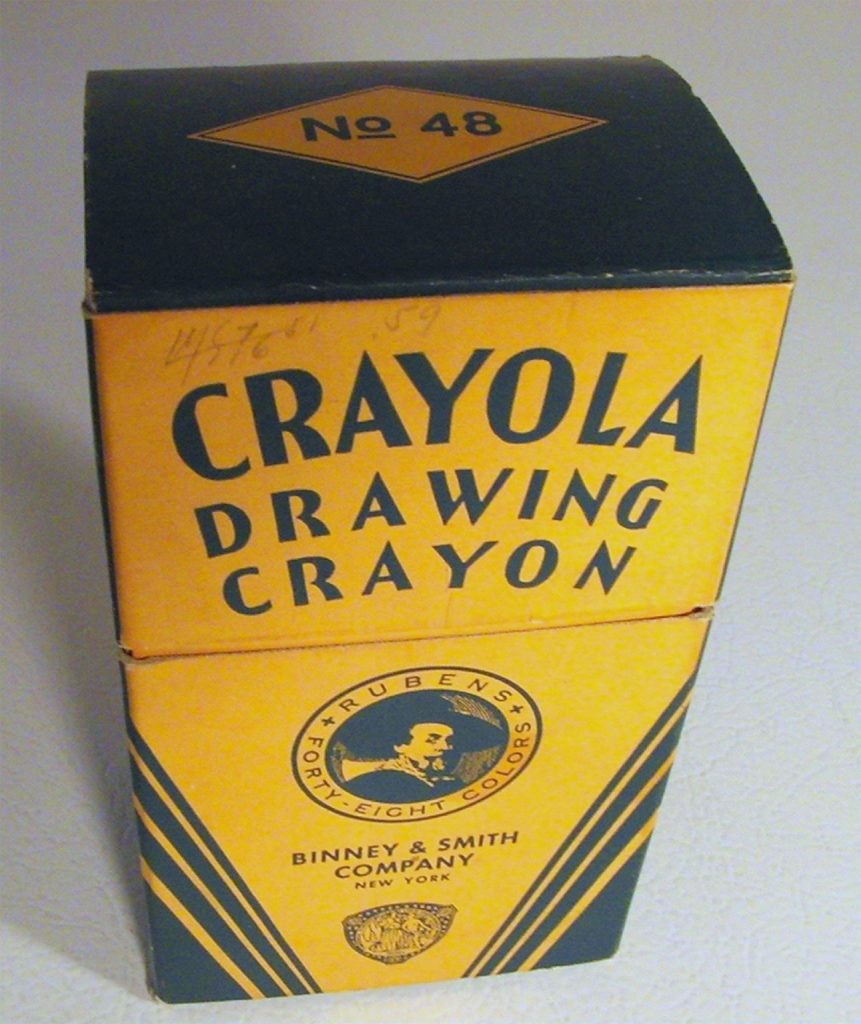
Crayola expanded its offering of colors to include a 48 box in 1949. Then, in 1958 (when I was eight), Crayola introduced the mighty 64-color box. Not only did the box include a built-in sharpener (a first), but there were 16 new colors (can you say aquamarine?). Think about this list of new colors: copper, lavender, raw sienna, burnt orange, goldenrod, sepia, plum, sky blue, and then add aquamarine to the mix and imagine all of the possibilities for artistic endeavors available to an eight-year-old wielding a box of 64-count Crayola Crayons with its distinctive green and yellow chevron design.
In 1972 eight fluorescent colors including ultra red, hot magenta and chartreuse were added to make a large assortment of 72 colors. For the box’s 40th anniversary in 1998, one of the original 64-color Crayola crayon boxes from 1958 was given to the Smithsonian’s National Museum of American History. It was handed over at a celebration in Manhattan’s Rainbow Room, where Bob Keeshan, better known as TV’s Captain Kangaroo, was one of the guests.
4. Prussian Blue, Flesh and Indian Red
Crayola has renamed colors as the times changed. Prussian blue was renamed midnight blue in 1958 in response to teachers’ requests, because according to teachers, children could no longer relate to Prussian history. In 1962 Crayola renamed its flesh-colored crayon peach. The change was Crayola’s idea and was inspired in part by the U.S. Civil Rights Movement; the new name recognized that not everyone’s skin is the same shade.
Indian red was added to Crayola’s 64 box of crayons in 1958. The color is named after a pigment found near India which produces a reddish-brown color. In 1999, Indian red was renamed chestnut because educators felt some children wrongly assumed Indian red referred to the color of Native American skin. Crayola received more than 250,000 color-name suggestions, and chestnut was the winner.
In 1972, the Johnson Publishing Company of Chicago published Color Me Brown, a story-coloring book which features 29 Black Americans in verse. Written by Lucille H. Giles, Color Me Brown was illustrated by Louis F. Holmes.
5. Whitman, Saalfield and Merrill
Many of the coloring books were produced by a handful of major publishers, often at surprisingly inexpensive prices. Whitman Publishing Company was the children’s book publishing division of Western Printing & Lithographing of Racine, Wisconsin. In 1916 Western acquired a publishing company in Chicago and moved it to Racine, Wisconsin. By 1987 Western Publishing was one of the largest producers of jigsaw puzzles and coloring books in the world.
The Saalfield Publishing Company of Akron, Ohio, published children’s books from 1899 to 1977 and was at one time one of the world’s largest publishers of children’s materials. The library and archives of The Saalfield Publishing Company were acquired by Kent State University (where I was a student in 1970) in April of 1977. The collection includes items such as paper dolls, follow-the-dot activity books, sewing cards, Shirley Temple coloring books, and, of course, plenty of vintage coloring books.
Merrill Publishing Company of Chicago produced coloring books and paper dolls. Its owner, Marion Elizabeth Merrill, insisted on high-quality art even for books that sold for 29 cents. And that price, 29 cents, sounds incredibly inexpensive today.
6. A Cowboy on Every Cover
In the early 1950s western-themed books filled the coloring-book racks. Saalfield’s titles from 1950 and 1951 include Cowboys on the Range, Bar Z Cowboys, Ropin’ and Ridin’, The Real Cowboy Coloring Book, The Cisco Kid and Pancho, and a John Wayne coloring book. In the mid-1950s Whitman published Roy Rogers’ and Dale Evans Big Book to Color (1954) and a Gene Autry Coloring Book (1955). Copies of the latter two books are part of the collections of the National Museum of American History, a division of the Smithsonian.
Before my family had a TV, we listened to The Lone Ranger on the radio. Radio gave us the hero’s voice, and a coloring book put the hero in our hands, where we could choose to make his horse blue or brown or any color we wanted.
Did You Know?
Not every grown-up approved of coloring books. Art educator Viktor Lowenfeld argued that they limited children’s creativity.
And if the smell of a fresh crayon box takes you right back, you’re in good company: a Yale University study of scent recognition ranked crayons 18th among the 20 smells most recognizable to American adults.
7. Your Favorite TV Show, in Outline
As the TV made its way into the living room, the TV shows made their way into coloring-book format. Saalfield published Tom Corbett, Space Cadet (1952) followed by Ozzie and Harriet, David and Ricky (1954), Crusader Rabbit (1957), Combat (1963), That Girl, starring Marlo Thomas (1967) and, by 1968, they were publishing Peanuts coloring books. Whitman published Bob Clampett’s Beany Coloring Book (1953) and The Lennon Sisters Coloring Book (1960), that would be Lawrence Welk’s singing sisters. Later, Saalfield published The New Zoo Revue (1973), Sigmund and the Sea Monsters (1974), and Star Trek (1975).
You’d pick one up at the drugstore or five-and-dime (it wouldn’t cost much) and take the characters home with you. And it wasn’t just TV stars, either: movie stars made their way into coloring books, as well. The Smithsonian’s collection includes ’50s coloring books of Elizabeth Taylor, Doris Day, Grace Kelly, and Debbie Reynolds.
8. Wet a Brush and Bring Out the Colors
Paint-with-water books eliminated the need for the paint box, as color was already incorporated into the image. You dipped your brush, brushed it over the picture and watched the color appear. All it took was a brush, a glass of water, and patience as the page dried and puckered.
During the 1940s and into the 1950s, Saalfield called these books, appropriately, Wet a Brush and Bring Out Colors. The title of the 1953 book says it all: “Surprise Pictures Will Appear.” Saalfield called the 1958 version Paint Without Paints.
You’ll even see products today, such as Melissa & Doug’s Water Wow! pads, billed as a no-mess painting activity for kids.
9. The Magic Slate
The Magic Slate was originally invented as a time sheet at an old corset factory. In 1923, R. A. Watkins, the caretaker of an abandoned corset factory in Aurora, Illinois, discovered that combining leftover scraps of corset plastic with a wax board produced a slate on which you could repeatedly write. When his own kids took an interest, Watkins realized that the slate could be a popular toy, so he teamed up with a business associate to produce and sell them.
Each Magic Slate is a piece of cardboard covered by a thin, clear plastic sheet. The cardboard is coated with a dark, waxy material. You can write on them with a stylus, but when you lift the plastic sheet, it comes away from the wax and removes all evidence of your masterpiece.
The slate business was acquired by Western Publishing in 1958. In 1987, Representatives Dan Mica and Olympia Snowe visited Moscow to tour the U.S. Embassy then under construction. To keep from having their conversations overheard, the State Department told the two representatives to carry around 99-cent Magic Slates to jot down anything sensitive. One of their aides picked up a dozen at a local Toys “R” Us, and Western Publishing sent the State Department 25 cases. Western was planning to make about 6 million Magic Slates that year.
Price Check
- 5 cents: the first box of eight Crayola crayons, 1903
- 29 cents: a Merrill coloring or paper-doll book from Chicago
- 99 cents: a Magic Slate in 1987, the year it went to Moscow
10. When the Grown-Ups Got Coloring Books
Now, if only there was something for adults. Well, there was, and it turned into a whole craze.
It all started with The Executive Coloring Book by Marcie Hans, Dennis Altman and Martin A. Cohen published in 1961. It was the first coloring book published specifically for adults, and it poked fun at corporate conformity, with captions like “This is my suit. Color it gray or I will lose my job.” It was a New York Times bestseller. It was published again by G.P. Putnam’s Sons in 2017.
In 1962 there was a coloring book about President John F. Kennedy, drawn by Mort Drucker, that was the New York Times No. 1 bestseller for 14 weeks.
In 1962 journalist Milton Bracker wrote a piece in the New York Times about the phenomenon of adult coloring books that turned up one man who admitted coloring in all the adult coloring books he could get his hands on, and he worked for a crayon company. Other adult coloring books of the time made fun of the Soviet Union, the John Birch Society and other targets.
11. Coloring Books With a Message
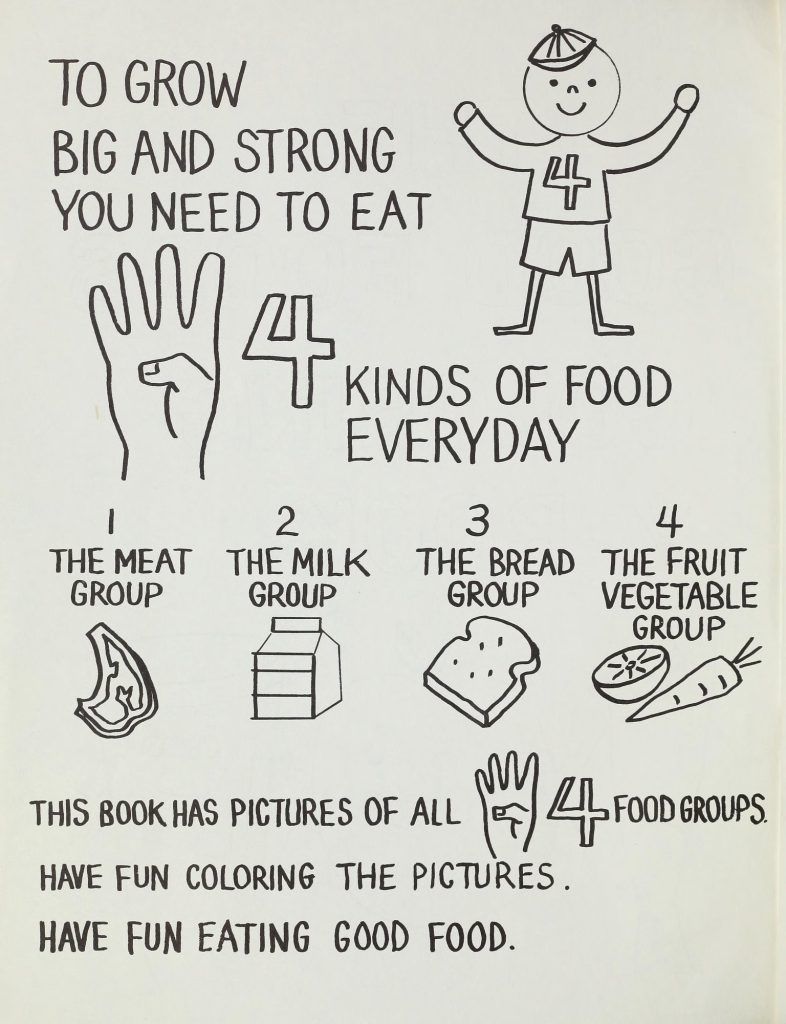
Coloring books have been used to spread messages for many different purposes, ranging from commercial interests to educational messages from the government.
In the 1920s the National Lead Company, which made lead paints, released painting books during its Dutch Boy campaign. Those Dutch Boy painting books are hard to look at now that we know the effects that lead paint has on children.
In 1968 the U.S. Department of Agriculture published The Good Foods Coloring Book to teach children the importance of eating from four food groups every day to help them grow up big and strong: the meat, milk, bread, and fruit-vegetable groups. In 1974 the U.S. Department of Justice’s Bureau of Narcotics and Dangerous Drugs published Katy’s Coloring Book About Drugs and Health, a coloring book with a kangaroo on the cover that taught children about drugs and health.
12. Dover’s Retro Coloring Books for Grown-Ups
Dover Publications offers retro-themed coloring books sure to evoke memories of the cars, clothes, and magazines of yesteryear.
If horsepower gets your pulse pounding, grab Classic Cars of the Fifties Coloring Book illustrated by Bruce LaFontaine. Color a 1953 Buick Skylark convertible, 1957 Chevrolet Bel Air hardtop or a 1958 Ford Edsel sedan. Or, American Muscle Cars, 1960-1975 Coloring Book also illustrated by Bruce LaFontaine features 44 cars to color including a 1964 Corvette Stingray or 1970 Dodge Challenger R/T, cars that epitomize freedom and an open road.
If you’d rather remember fabulous fashions instead of fabulous fastbacks, grab Creative Haven Fabulous Fashions of the 1950s Coloring Book illustrated by Ming-Ju Sun featuring 31 pages of outfits including full skirts, cardigans, capri pants and men’s fashion for business and casual wear. There’s a 1960s version, too, for miniskirts and bell bottoms.
If you remember Norman Rockwell’s traditional American illustrations from The Saturday Evening Post, you’ll be happy to color 31 magazine covers in Creative Haven Norman Rockwell’s American Life from The Saturday Evening Post Coloring Book including New T.V. Set and Girl at Mirror.
The pages of the Creative Haven fashion books are printed on one side only and perforated for easy removal for framing or displaying on the refrigerator.
13. The 64 Box Is Still on the Shelf
Crayola still makes the 64 box (still with the built-in sharpener), and its product page suggests pairing the Crayolas with a coloring book as a gift.
Libraries, museums and archives take part in the annual #ColorOurCollections campaign, which began in 2016 with a project by the New York Academy of Medicine Library. Every February, usually in the first full week, participants release images from their collections transformed into coloring sheets that anyone can download for free, color, and post pictures of. The Academy has all prior years’ books on its website, ready to download and print. Sit down at the kitchen table with your grandchild, pull out some sheets and a box of Crayolas, and enjoy a quiet afternoon together.
Did you get the 48 box or the 64 box? What TV show or cowboy star graced the front of your most beloved coloring book? Did you actually stick to the lines? Please share your stories with me in the comments.
If coloring books take you back to Saturday mornings on the living-room floor, you might also enjoy Saturday Morning Cartoons: When One Morning of TV Was Worth the Whole Week’s Wait and Marbles, Jacks & a Piece of Chalk: The Toys That Never Needed Batteries.
Top photo: The first version of the Crayola No. 64 box, with its “New Built-in Sharpener” banner. Photo: Kurt Baty / Wikimedia Commons, CC BY-SA 3.0 (cropped).
Photographs are in the public domain or used under Creative Commons licenses, as credited in each caption.
.jpg)

.jpg)

Leave a Reply